 Santa Claus and his elves watch closely as the Lady Colts defeat North Hills 51-42 Wednesday night. No word if Mrs. Claus was also in attendance. Read both the boys and girls varsity basketball game stories on Chartiers Valley Patch.
Rabu, 22 Desember 2010
He sees you when you're... ballin'
Santa Claus and his elves watch closely as the Lady Colts defeat North Hills 51-42 Wednesday night. No word if Mrs. Claus was also in attendance. Read both the boys and girls varsity basketball game stories on Chartiers Valley Patch.

Our favorite Docs things - 2010 Year in Review
[Cross-posted from the Google Docs Blog]
In addition to some of the most requested favorite features like mobile editing, OCR, advanced sorting rules and a more consistent look, here are more of our team’s favorite things from this last year:
- A new Google Docs built from the ground up for real-time collaboration
- The new Google drawings editor for making flowcharts, diagrams and more
- Upload and store your files in the cloud and stop worrying about losing files
- Simplified sharing with new features like “Private”
- New charts editor and chart types because pictures are worth 1000 words
- New revision history UI in documents and spreadsheets make it easier to see what has changed
- Horizontal navigation in Sites gives you more options when building your sites
- More fonts in documents provide you with more ways to express yourself
- Formula highlighting in spreadsheets makes it easier to understand your formulas
- Google Docs demo makes it easier for anyone to try Google Docs
On behalf of the entire the Google Docs and Google Sites teams, happy holidays! We’ll see you in the New Year!
Selasa, 21 Desember 2010
Way out of the box presure system...
Another out there concept... this won't work with the muiulti segment tank of the last wild idea, but will work for a single tank.
In a H2O2 rocket 80% of the propellant volume is H2O2, so you need to pay more attention to the H2O2 side than the fuel side.
Leave a small space at the top of the H2O2 tank. In this space put a solid silver screen/catalyst hung from a thermally compatible string. Unwind the string into the tank letting the silver decompose the H2O2 pressurizing the tank, raise and lower the catalyst to control pressure.
Fuel is pressurized with a bladder from the gas in the main oxidizer tank.
Main propellant valve is a simple burst disk.
In a H2O2 rocket 80% of the propellant volume is H2O2, so you need to pay more attention to the H2O2 side than the fuel side.
Leave a small space at the top of the H2O2 tank. In this space put a solid silver screen/catalyst hung from a thermally compatible string. Unwind the string into the tank letting the silver decompose the H2O2 pressurizing the tank, raise and lower the catalyst to control pressure.
Fuel is pressurized with a bladder from the gas in the main oxidizer tank.
Main propellant valve is a simple burst disk.
Enhance your productivity with more applications for Google Apps
[Cross-posted from the Google Enterprise Blog]

Last month we launched an improvement that makes more than 60 additional Google services available to Google Apps users. Since the launch, we’ve featured posts from product teams across Google to showcase how you can benefit from the new services.
Our colleagues working on Google Reader, Google Alerts, Google News, and Google Finance described how their products give you new ways to discover content on the web. The Blogger and YouTube teams shared how their services can be used to connect with your customers and communicate information about your products and brand. We also featured posts from the Google Analytics, Google Website Optimizer, Google Custom Search, and Google Translator Toolkit teams to highligh tools that help your company build and optimize your web property. Posts from Google AdWords and Google Places showed how you can make it easier for potential customers to discover your business when they are searching online, and a post from Google Checkout described how you can let visitors purchase products from your site once they arrive. And if your business isn’t built around an online transaction model, the Google AdSense and DoubleClick for Publishers teams outlined tools that you can use to efficiently monetize traffic to your website. We also featured posts on Picasa Web Albums and Google SketchUp & 3D Warehouse that highlighted use cases for sharing and editing photos and 3D images at your organization. Finally, posts from Google Voice and Google Chrome Sync featured products that leverage the power of the web to allow you to work seamlessly across multiple devices, so you’re not tied to your desk phone or desktop PC to be productive.
This series has highlighted a few ways that you can use these additional Google applications, and we’re confident that you will discover many new and interesting use cases that fit your business. You can explore even more exciting Google services now available with your Google Apps account at http://www.google.com/apps/more.
All of these new services can be enabled by your domain administrator from the Google Apps Control Panel at https://www.google.com/a/[your_domain.com] (replace [your_domain.com] with your actual domain name). Your domain administrator can grant different groups of users access to different sets of applications, so your company can get up and running today with more than 60 productivity-boosting applications matched to those users that will benefit from them most.
Note: Some products may not be available in all areas.
Tips for creating a free business listing in Google Places: business types
Are you curious about what kind of businesses are eligible to appear in the free listings that appear on Google and Google Maps? In this second post in our blog series about how to create a clear and effective business listing via Google Places, we’ll help you to determine if Google Places is right for your business.
Business types and models that work with Google Places
Google Places is meant to facilitate customer interaction with brick-and-mortar businesses and service providers. Therefore, the business owner or employee who is officially authorized to represent their particular business location must have a physical address in order to comply with our quality guidelines.
Having a physical address means that your business has a specific location (typically including a street name and a street number), can be visited by potential customers or business partners, and has a specific phone number at that location where you can be reached during operating hours. Including your physical address in your free business listing helps customers figure out where they can find you.
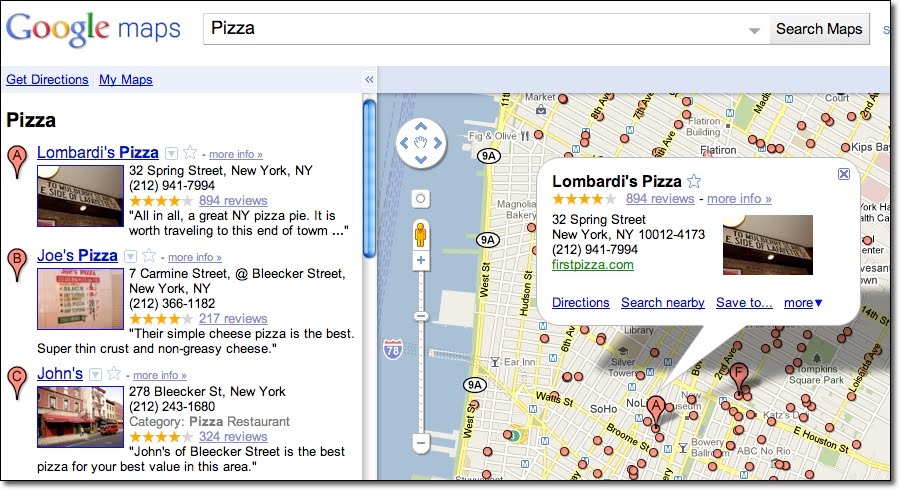
Examples of business listings displayed on Google Maps
Businesses that aren’t right for Google Places
Here are a few examples of business types that are not currently eligible to use Google Places:
- Web shops that operate exclusively online and have no office for visitor traffic or direct client interaction
- Businesses without actual physical locations (your living room, the airfield where you offer paragliding lessons, nor the river where your rafting tours start do not qualify as business locations)
- Companies with non-permanent locations like a farmers market stall, a mobile hot dog vendor, or a one-time concert event at a local café
- Real estate companies that don’t have a central office and are trying to advertise individual apartments where no one can be reached in person or by phone
For operations like these, rather than appearing in Google and Google Maps search results associated with a physical location, other online tools might better fit your needs. One option is to advertise and generate awareness about your business activities through Google AdWords. This cost-effective program enables you to get the word out about your business, website or event via online ad campaigns, and does not require you to have a brick-and-mortar business address.
How to create a free listing if you’re eligible
If you’re a business with a physical office location that is open to customers and staffed both in person and via phone during regular business hours, we encourage you to create a free listing by signing in to Google Places here. For example, a real estate company with a corporate office can add the services it offers, the apartments it sells, and so on in the description field of the listing.

Be careful to create just one listing per physical location and to create listings only at places where your business is actually located. For example, if you run a DJ service and your office is at 41 Broadway in New York, you should only add that location in Google Places, even if you also DJ at 32 Main Street and at 14 Smith Street.
How to indicate service areas
For businesses that have one physical location but also offer their services elsewhere - such as the aforementioned businesses as well as locksmiths, translation services, delivery pizzerias, cleaning services and the like - you can use the Service Areas feature in your Google Places account. Marking a service area enables you to show your potential customers the range of places where you work.

Businesses that require travel to meet customers can define a radius around their main location or select specific areas they serve. If your main location is your home address and only used to receive business-related mail and phone calls, you can also hide that address and only show the service area in which you operate. This might be the case for babysitters, DJs, household services or IT repair services. Detailed instructions about how to set up this feature can be found in our help center.
Taxi and courier companies are particularly good examples for the use of the Service Areas feature. They offer a service that is location-independent and therefore shouldn't be associated with fixed locations on Google Maps. Even if you can find taxis often in front of train stations or airports, these are not locations owned by the business. The service area feature allows taxis to indicate the area in which they operate. If the taxis are coordinated over a dispatch centre, that can be listed as one physical location, otherwise the address should be hidden.
How to verify a listing
In order for your free business listing to appear on Google and Google Maps, you must verify your business via Google Places. This simple process includes providing a verification code by mail, automated call or text message. The phone number used for this process will be shown in your listing, so be sure that the number directs calls to your business.
We hope this information helps to explain our Google Places quality guidelines around setting up a free business listing. If you have any further questions about the types of businesses that are eligible for inclusion in Google Places, please visit our Google Places help forum.
Posted by Lina Paczensky, Local Search Quality
Senin, 20 Desember 2010
Way out of the box...

A 3rd stage made of 3L soda bottles surrounding a 3U Cube sat.
3L soda bottles are good to 100PSI with a Mass ratio of > 40 when used with H2O2.
The "goodness" of normal rocket tanks are usually rated by the PV/mass. The best aerospace composite tanks, like the Scorpius pressurization tanks used by Armadillo in the 180sec super mod can have mass ratios of better than 9 at 2200 PSI working pressure. If you could scale this to a 200 PSI tank then you get a water filled tank mass ratio of >80. The fundamental problem is for the small sizes we are talking about you can never get that low. The tank wall would be paper thin. At small sizes the issues are minimum gage not minimum strength. (Hard to beat a soda bottle 0.25mm thick. )
As soon as you go up in size bigger than minimalist nano sat launcher then properly built aerospace quality tanks are a must.
I also suspect that when fighting minimum gage issues going up in pressure for a tiny launcher can have benefits in motors size, expansion ratio, flow path sizes etc....
A big puzzle with too many knobs.
UPDATE:
Here is a link to the specs for high quality aerospace tanks...
Display advertising helps one small business minimize India’s education gap
Dinesh Mehta and Rajat Verma had always been aware of inequities in India’s educational system. As the gap widened, Mehta and Verma wondered how they could use technology to provide higher quality education to more people. In 2006, they founded TopChalks.com to provide technology enabled educational and training solutions for a wider population.
TopChalks works with some of India’s best instructors to develop and produce educational content for digital platforms. ‘With TopChalks content, students have the option to study online, with CDs, through handheld devices or on digital broadcast platforms such as digital cable TV,’ says Director of Products and Engineering Vishal Chadhuary.

TopChalks ambassador Javgal Srinath (Indian Cricketer)
Since TopChalks seeks to democratize education largely via digital content, Chadhaury turned to the Google Display Network to market the educational experience. ‘Our products are very unique in nature,’ says Chadhuary. ‘Once we show potential customers what we are offering, they better understand our products. All our ads have a demo button which leads to an actual product demo.’
To ensure he’s seeing positive results from his display ads, Chadhuary pays close attention to the performance of the ads across the Display Network. ‘We keep a close eye on which sites to exclude or add as managed placements,’ says Chadhuary. ‘When we see a site with a stronger clickthrough rate, for example, we might add this site as a managed placement.’
Chadhuary also monitors the effectiveness of his display ads by testing multiple formats for each ad. He then tracks the clickthrough rate of each ad and either pauses the poorer performing ads or edits them to mimic the well performing ads.

TopChalks ambassador Javgal Srinath (Indian Cricketer)
Chadhuary’s diligence with the Google Display Network proves that small businesses can use display advertising to generate new business. ‘Now we get well over half of our leads from ads on the Google Display Network,’ says Chadhuary. ‘There are numerous education websites with great content and millions of users. Showing relevant ads there generates good quality leads for us.’
Mehta, Verma, and Chadhuary’s vision to impact India’s education is spreading with rapid success. With the help of display ads, they are able to clearly communicate and actually show customers what they can achieve with TopChalk’s help. ‘With India growing at a rate that it is, we believe that such growth cannot be sustained and will not be meaningful unless we think out of the box and educate the masses,’ says Chadhuary. ‘Every person in the company is driven by this vision.’
Posted by Julian Sonego, Marketing Manager, Google Display Network
Langganan:
Postingan (Atom)