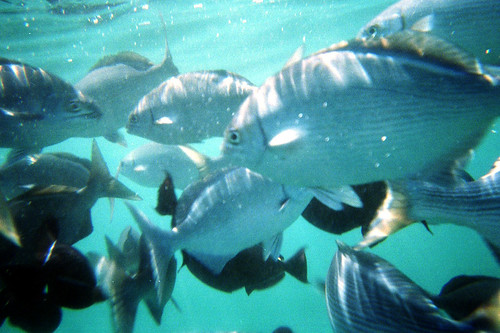
“Poorly tied knots will mean lost fish and aggravation.” - Killroy’s Fly Fishing
Readers are not fish, but if you want to entice them to nibble on your novel, you need to take as much care as an OCD fly-fisherman tying knots. (Note: I know nothing about catching fish, but I’ve learned a great deal about hooking readers in the last year of self-publishing).
The Hook
I have great respect for my readers’ time. They have busy lives, and if I want them to spend hours and hours reading my novel, I need to show them, up front, that it will be worth their time. A great (professionally designed) cover is required to visually draw people in. But readers are literate creatures—they want words that beguile and speak to them, and it is your words that will hook them.
I’m a big fan of tag lines, those pithy nuggets of story that light up the curiosity centers of your readers’ brains. If you blanch at the idea of distilling your novel into a paragraph-long blurb, try writing 12 words or less that describe it. No, seriously, try. Even if you do not use the tag line in your marketing (but you will), the exercise will encapsulate the key reason to read your novel. Your tag line should work alone, as well as coordinate with your title. Like a good fly-fishing knot, it will take time to craft, but it will be worth it in the end. I’ll use one of mine as an example to deconstruct how/why it works:
When everyone reads minds, a secret is a dangerous thing to keep.
From just 12 words, the reader knows the novel is science fiction/paranormal (“everyone reads minds”), there’s tension between the (unnamed) character (with a secret) and the world (where everyone reads minds), it’s specifically intriguing (a telepathic world— how does that work?), and it’s high stakes (“dangerous”). So I’ve communicated genre and conflict with a specific twist. Add a title (“Open Minds, Book One of the Mindjack Trilogy”) and a succinct blurb (95-130 words max), and you’ve hooked your reader. Even more importantly, you’ve made a promise. You’ve whispered into your reader’s ear, I can intrigue you in just twelve words—imagine what I can do with more.
How can they resist?
The Line
You can have the most alluring of marketing packages (cover/blurb/price), but if you try to catch fish in a desert, you’re going to be bummed. Likewise, don’t keep fishing in the same tiny creek that runs along the edge of your backyard (translation: don’t keep marketing to the same people over and over; social marketing can help, but keep it primarily social). You need to constantly cast your line into new ponds to find new fish.
Sounds exhausting, yes?
Fortunately, Amazon does a lot of the casting for you. Their algorithms (and to a much lesser degree, other online retailers) perpetually try to match your book to readers. But their algorithms are fueled by two things: sales and reviews. Book bloggers are a great source of reviews, as well as representing new ponds to fish in (note: blog touring on your friend's blogs is fishing in your back yard again - some is fine, but you need to reach beyond that). Some paid advertising, combined with discounts (including a free book, when it's the first in a series), can be extraordinarily effective in spurring sales, but look for recommendations (Kindle Boards is a good place to start) as to which ads can deliver results. The only ads I've ever seen deliver, personally, are Pixel of Ink (which you cannot purchase, but your book may get picked up if it's free) and Kindle Fire Department. The best ads are ones with subscription services, i.e. readers have subscribed to receive emails about books that might interest them. This is an audience that is looking for books to read. Perfect! The fish are ready and waiting, and if your hook is well baited, they might just bite.
And The Sinker
“Many men go fishing all of their lives without knowing that it is not fish they are after.” - Henry David Thoreau
You’ve found your reader and hooked them with a great cover/blurb/tagline. They’ve paid for your novel (or perhaps downloaded it for free) and they are expecting some entertainment.
You need to deliver on that promise you made in your hook.
This is how you turn a customer into a fan. Because we’re not just after readers, are we? We want people who will be moved to laughter and tears and write five paragraph reviews and tell all their friends. That connection with the reader, at least for me, is the reason I spend crazy amounts of hours toiling over my manuscript. How do you create a novel that will turn readers into fans and build the word-of-mouth that is the only true marketing your book needs? This is where the craft of writing comes in.
A recent survey shows that the most successful self-publishers spend 24% more time per word than their less successful self-published colleagues. I believe this is the first key to creating a book that sells well. The second is multiple rounds with critique partners (preferably writers like you, not family/friends). I usually have at least three rounds of critiques, with 2-5 different critique partners each round (and I return the favor whenever possible, not least because I learn as much by critiquing my friends’ novels as I do from their critiques of mine). My novels are profoundly better with their help. Write, revise, rewrite again until that novel is shiny and ready for the world (and a good copyeditor wouldn’t hurt either). Keep your focus on delivering a satisfying story for your readers. Then publish, and let your readers decide if your novel has them clamoring for more. If not, learn from their feedback and write another one. And another. Want to know the secret to doubling your sales? Write another book. When you have a dozen fishing poles in the pond, you’re much more likely to hook a passing reader.
Refining your craft is a lifelong process. Your first book will not be your best (at least, it shouldn’t; hopefully you will continue to learn and improve). However, every book you publish should be the best you can produce at that time.
Your readers deserve no less. And dedication to a quality story, more than anything, will keep them coming back for more.
What do you think are the key factors in selling a book?
What do you think are the key factors in selling a book?
~*~


Tidak ada komentar:
Posting Komentar