Rabu, 19 Januari 2011

What a Business

Do you think of trading as: "What a business!" or "What? A business?".

My Dad developed real estate. His projects were always successful unless he got caught by the cyclical recessions that came and went. This taught me a couple of important lessons which I apply to my business.

Firstly, when, as a boy,  I asked him how he knew that the project was going to be successful he said, "I make my profit going into the project. I do my research and then I buy the land and improve it's value by getting a building approval onto it. I then build the building while I sell it to buyers off the plan. I know it will be profitable because each step improves value."  This taught me to do a lot of preparation in my methodology and make sure that the odds were on my side when going into a trade. Assuring my profit going in.

The second lesson I learned is that stuff happens. Recessions come, wars break out, announcements are made. Don't take overnight positions.

Although I have wandered from this last lesson somewhat, I do it in a very protected way. I use options extensively as part of my strategies. The bulk of what I make comes from intraday, as it's safer. Lots of smaller risks are more comfortable than one larger risk.

So in constructing a TP, these are the things to also keep in mind. It's not very different to any other type of business in that respect. Can you imagine a business surviving if it only made profits on, say, 40% of it's sales and lost money on the other 60%?

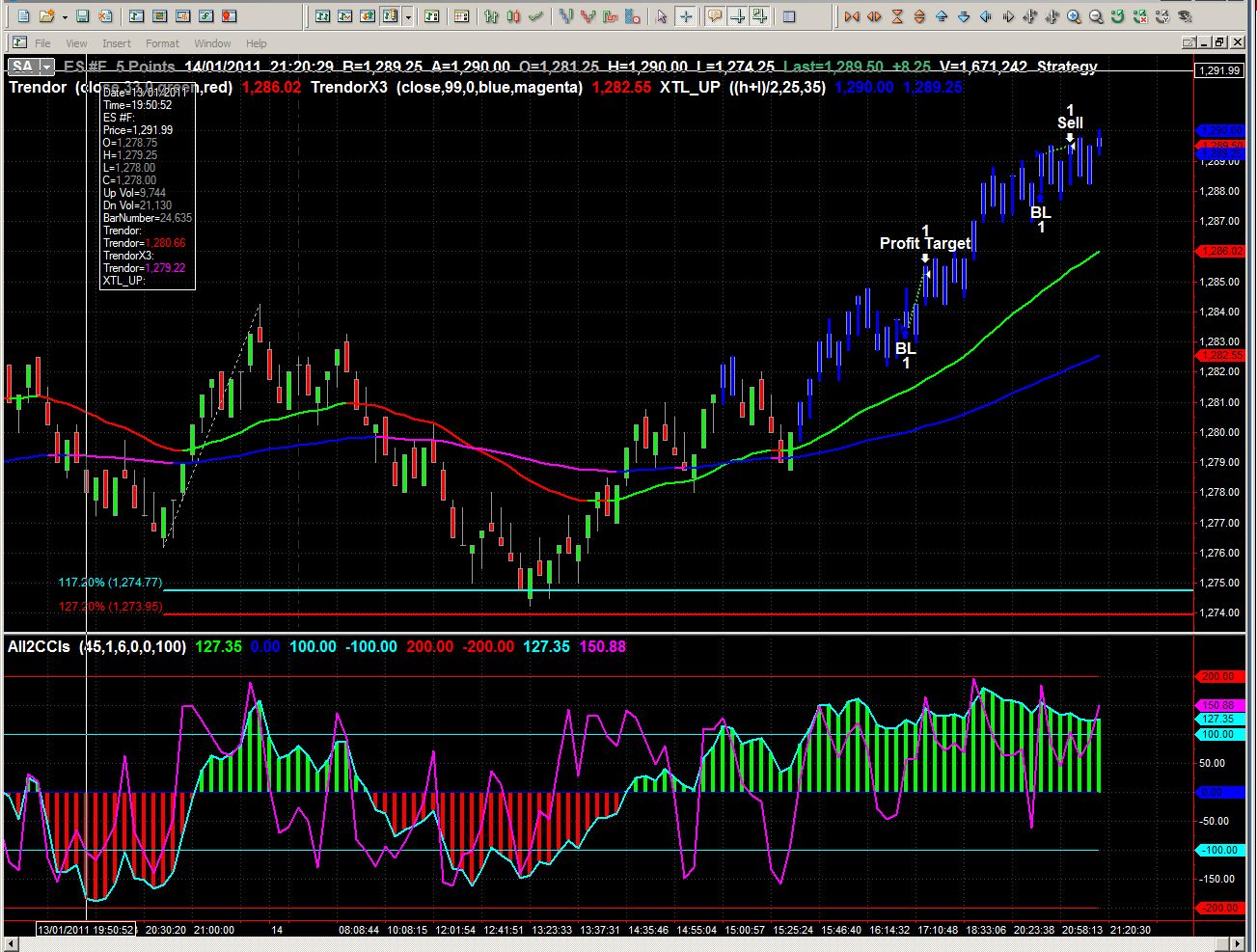
Due to the way I envisioned today, I did NOT tweet the Gap trade. The market went down as I envisioned. I'm showing a 3 tick range bar chart today to show what I do when I want to see more or scalp. As it turned out, today this chart gave a much better entry into the ES shorts than the 5 or 6 range bar chart.  Price did the right thing and hit my Fib line targets too. This is discretionary trading.


Selasa, 18 Januari 2011

Trading Every Day to Make a Living: Part 4

OK, we have all the ideas in Parts 1 to 3. Now how do you make at least $250 a day?

It's all based on your win rate.

As a rule of thumb, the closer the target of your trade, the higher the win rate. I want a win rate of at least 75%. In the design of the strategy, I also have to match the drop dead stop loss or use an optimised or logic based stop (eg ATR stop or MOMDOT Stop or EMA stop, etc) to the strategy. The type and design of the stop loss is also dependent upon whether I want to trade by HT or completely automated.

OK, my target is $250 per day or 5 ES points or, better still in today's markets, 20 Euro futures ticks.

After building, back testing and forward walking (SIM) my HT system, I arrive at, say, the following stats, for the Euro in this example (real example from my trading):

Win rate 80%
Average win/Contract: $112.50
Average loss/Contract: $212.50

For every 10 trades I make 8 x $112.50 = $900
For every 10 trades I lose 2 x $212.50   = $425
I pay brokerage                                    = $60
                                                            ________
Net Profit                                              = $415

There is an average of 12 trades a day during the hours I would trade, so my $250/ day is doable on the maths. My testing is confined to my trading hours. If the number of trades are fewer, or the net profit less, then I would have to adjust the number of contracts traded so that my expected profitability is more than the $250 plus the buffer, as I explain below.

As I have a 20% loss rate, I take my daily profit requirement and add 20% to it to make it $300.

I now implement my strategy. I KNOW my trader's profile because it has been tested. I trade every day until I make $300. The extra $50 will pay for any losing days. If I want to make $500/day, I double the number of contracts. I don't trade longer hours unless the TP has been revised and tested as before.

When creating a trading algo for both fully automated trading and HT, there are a number of DON'T DOs, which include:
1. Don't create a strategy based on curve fitting rather than fitting the strategy to the market. Curve fitting shows a mythical profitability as there is  No real "edge". The methodology I use is all described in this blog. The DVD training sets out the trading pictures in detail and show, live, how I trade them. Incorporating these into HT is an extra programming step but many of you will have already done that as part of your back testing. You can use any alternative strategy that you find suits you and have tested correctly.
2. Don't leave out testing properly and Don't forget the importance of forward walking. Unless the traders profile is known, #3 will kill this idea because of this "don't".
3. Don't cherry pick trades. Not sticking to the strategy because the trader has not done the work to KNOW their trade profile and thus not having the confidence to follow his own rules is a definite way to find it hard to trade successfully.

I firmly believe that no matter what anyone says, the high win rate is a critical psychological component of CP. Most of us find it hard to put on a trade that may have a significant financial impact if our statistics show that there is, say,  a 60% chance of it being a loser. That's one of the reasons I have my students trade the most minuscule size possible when they start so that no matter what, the financial impact is the least possible. It's just easier to maintain discipline.

Below is the chart of this morning's (London time) Euro trading. As you can see, there were 5 trades, 4 winners and 1 loser. The winners each made 14 ticks per contract and the loser lost 14 ticks- all on a fully automated basis. As HT, I ran the 4 winners as is, but managed to cut the loss on the loser to 11 ticks. The net result was $475 as fully auto and just over $500 on an HT basis, all per contract. After the 5th trade, I turned Flo off, as I was finished for the morning.


This morning I tweeted, London time:
$ES_F Looking for resistance for the Gap trade at 1293/94 area. Blast past 94 invalidates. Jan. 18 at 11:05 AM

Price touched the 1293.00 and was easy to see the short at 1292.25 - a great trade down to 1286.75 where I covered at my Fib number. These Gap trades are high win rate trades and are very black and white to do and you can easily see when you are wrong.

Senin, 17 Januari 2011

Trading Every Day to Make a Living: Part 3

The way I set up my auto trader, Flo, for Hybrid Trading is very different to the parameters for my algos of the completely unattended auto trading. While the methodology is the same, the way that it is managed is different. There, I'm after the best return on investment, unattended.

There was a comment to Friday's part 2 post saying: "Your losers are three times as big as your winners so wouldn't the drawdowns (troughs) be large?" The annual maximum drawdown ran at less than $2,000 per contract traded as a fully automated basis and on a managed basis I estimated it to be half that. By using HT, the average losses are NOT three times as big as my winners. That's the point of HT. But even if they were, the high win rate makes the overall method profitable, as long as the winning trades are traded to a reasonable percentage of their potential.

For HT, I am after a high win rate only, with optimised drop dead stops and optimised first scale out points.  The aim of HT is to increase profitability from that base using discretionary but rule based trade management.

I put the above in bold because it's important to understand this. Every trade's outcome is different, although the general entry criteria may be the same. It's what happens after the entry that determines the outcome. I look for trade entries that fit my Trading Plan. However, I cannot program in all the context that, as a discretionary trader, I use. So Flo enters in HT mode with an optimised drop dead stop and optimised or money related first scale out target. I then have to manage the trade.

Some trades I scratch straight away. For example, a long just below a strong resistance and that has the odds against the trade, I scratch. I manage my losing trades so as not to lose the whole drop dead stop. I typically have a drop dead stop of around  $300/contract for the ES in case I need to double down. But I rarely use it. The market tells me to get out much earlier, but as it's different for every trade and not a fixed number, I can't as yet program all the possibilities. Also, using HT, I can add trades that Flo misses.

The same goes for profit targets. Every trade is different. Using a fixed profit target would limit my profitability, so I have a first scale programmed where I exit at least a third, but I manage the rest. I have a version of Flo HT with scaling out built in that I use when I'm not paying attention. It does well but not as well as when I manage manually. Again, because every trade is different, I manage my exits to make sure that I can earn the most after assuming the risk of the trade.

When setting up Flo to run in a purely automated way, the result is that the win rate is lower and the trade profile is very different. 

HT can be used in many ways but I see a lot of merit in it for many traders, as HT helps get into the trades in a consistent and disciplined manner. This is a big component of what is required for Hybrid Trading. Managing the trades after entry can be done using strict rules that are consistently applied.

Beginning traders can start with a more robotic approach, having programmed stops and scaled out exits, and as their skill level improves with screen time, they can slowly take more hands on control.


On Saturday, I sent the screen shot above to one of my students. It is Friday's ES RTH trading. This is a good example of HT . As I said, We have programmed Flo to achieve fairly high win rates and profitability, yet there are times when I override her by scratching a trade, moving profit targets up or down, or moving stops closer (never further).

The question I have been asked is "Why?" If Flo is doing OK, why do I mess with her? There is an opportunity cost to trading. If I'm risking my money, I want to maximise the return.

Looking at Friday's ES, the key to the RTH session was the Gap trade. I tweeted it a few times on previous days to draw your attention to this great type of opportunity. Friday's Gap was especially low risk and high reward for me because of the Fib point below that fit the MP context so perfectly. It was really easy to see if I had been wrong.

What followed from that successful Gap/Fib entry was that I had great confidence in Flo's long trades after that. In fact I increased size and did not exit the extra lots, as per Flo's all out exit, but rather scaled as I do manually and then reloaded at the next Flo long signal. The end result was a pretty awesome green day.

Looking at Flo's results, they were great. 100% for 2 trades, 2 ES points. Again, win rate is king. With a high win rate I can trade size with confidence, as the drawdown can be managed. With a low win rate the drawdowns can bury you without a trace and your account can be empty by the time the winning trades decide to appear and match your stats. The basis of what I teach students to get to CP is the maintenance of this high win rate. The psychological and financial criticality of this aspect of my strategy should not be under rated.

For me, HT is definitely the best of both worlds.

Holiday in the U.S. I traded a bit of Euro futures in the London morning but taking the rest of the day off.

Jumat, 14 Januari 2011

Trading Every Day to Make a Living: Part 2

Following on from Part 1:

OK, you have an 80% win rate and the drop dead stops look alright. The system is profitable, but perhaps only marginally, as you have used a reasonable first target to ensure a high win rate. Many times traders sacrifice the win rate by changing the targets, in order to become profitable on paper. They often do this to the point where the win rate drops to as low as, say, 35%. In the experience I have had with many traders, when this target changing happens, the trader can't follow the system, as he doesn't know when it's broken. Usually the system is curve fitted and, from the trader's experience, if he followed it he would lose all his money.

So, that doesn't work but what does? What I do is to keep the win rate, use it as a first scale out point and then manually manage the trade in accordance with rules that I can't program, as they are so context sensitive. I codify my rules in my TP so I have consistency.

The outcome is a high win rate and good profitability with low drawdown.

Today's early trades in the Euro future are a good example. The Flo managed trades were great, but the one I exited manually was obviously in trouble, so I used my rules to manually exit and saved the $300 drawdown and spent about $165 instead. If I do this every day, then the difference at the end of the month is very considerable. It's the EXIT to the trade that makes the difference.


More in Part 3.

Kamis, 13 Januari 2011

Trading Every Day to Make a Living: Part 1

Let's reverse engineer consistent profitability.

Start with how much money you need a month in order to trade full time for your living. I'll pick a number that I've heard from some of my students: $5,000. If that's not you, then take multiples of it. Out of this you pay all your costs and taxes too.

OK, $5,000/month is about $250 per trading day.

When you see the fluctuations in the market it doesn't look too hard, but not quite so easy to achieve without a structured methodology.

Now $250 is 5 ES points (or 20 ES ticks) or 20 Euro FX futures ticks. Still doesn't sound like it's hard. Now consider that these 20 ticks are the difference between your winning and losing trades. It could be 40 winning and 20 losing or 60 winning and 40 losing. I'm ignoring commissions, but the more you trade the more the broker gets out of your $250 and the more ticks you need to earn to get to keep $250. All assuming you can make more ticks than you lose.

This is where it gets interesting. What if you could be fairly sure of, say, an 80% win rate? Could that make you CP? Look at the stats below for a 1 month period of a stock index future.


In the next parts of this post in the next days, I'll explore how to exploit this information. How to lock in that $250 per day, and how to reduce that learning curve.

The chart today is of the Dow Eurostoxx50 that trades on Eurex. It shows how I used Flo to make entries and how I override the exits plus make additional entries. I have added some additional PaintBars so I can visual see some order flow details. The CYAN up arrows are additional manual entries and the RED down arrows are manual exits.


Rabu, 12 Januari 2011

Now available: Google Places with Hotpot for iPhone

[Cross-posted from the Hotpot Community blog]

We recently released Google Places with Hotpot in Google Maps for Android, and starting now, you can have that same great experience as an iPhone app. We realize the importance of finding places you’ll love while you’re out and about, no matter what mobile device you use. And Places with Hotpot not only helps you find places near where you are, it gives you the best places to go for you by personalizing your search results.

In case you aren’t familiar with Google Places, it lets you quickly search for places nearby and personalizes the results based on places you’ve rated. We get you started with a few popular search categories, but you can also tailor the list by adding your own favorite searches. This makes it fast and easy to find the best places for you with little fuss.


Use a default search category, save your own, or rate the nearest place quickly.

It can be pretty rewarding to discover a new place you love, but we also realize that there are some experiences you just can’t wait to share. So Places makes it super simple to rate a place with your iPhone while you’re there. Just fire up the app and hit “Rate now.” It will use your location to guess your current place and let you post a Hotpot review right from your phone. But it’s not just about getting to say what you think—the more you rate places, the more you’re sharing about your tastes and the more we can give you personally tailored recommendations.


Give your star rating and add optional details or a review so Hotpot knows your taste.

If you want to make things even tastier, just visit google.com/hotpot from your desktop computer. Here you can add friends to the mix and quickly rate all the places you already know. Once you’ve added friends, you’ll find your results seasoned not just with reviews from around the web and recommendations based on your own personal taste, but also with your friends’ opinions too.


Once you start rating and add friends, Places can give you personalized recommendations.

Get the Places app on your iPhone now by searching for Google Places in the App Store or going here.

This first version of Places is available for all iOS devices in English only. However, expect more features and improvements to roll out soon, including localization in many new languages. We’re hard at work to make Places with Hotpot more and more delicious.

Know when to Hold'em and Know when to Fold'em

Kenny said it all. I guess life and trading is all about timing.

I  posted a link to a Mark Douglas video a few days ago that stressed the importance of ACCEPTING THE RISK of your Trading Plan. If you're not taking or holding your trades then you are deep down NOT accepting the risk. It's important to know when to hold'em and know when to fold'em and it's difficult to know that without having done your homework.

The requirement for me is BELIEF. I can put my trades on and manage them because I BELIEVE, and I believe because I have back tested. Because I have back tested I can accept the risk, because I KNOW that I will be profitable over time. This is a 3 cornered chair; Testing, Belief and Acceptance. This makes for a stable trader's profile.

I'm working on some posts that show more of the maths that are involved in CP. There are a number of things to decide in order to create the necessary numbers. I'm hoping to have the first post of a series ready by tomorrow.

Today I tweeted:
$ES_F, My cup runeth over, nother Gap Trade setting up not much Res above so need to watch Order Flow & momo
I put my money where my tweet was and went short about 15 minutes before the RTH open @1278.25. This is one of the trades we spend time on in the course. The DVDs have me trading a couple of them live and shows how to handle this trade, even when it doesn't quite go as planned. See the vid below.