Kamis, 06 Januari 2011

Every Day's Stats Matter

Only today matters. Not yesterday's results, not tomorrow's hopes. Just today. It's all the todays that you put together that make up your week, your month and your year. It's the todays that mean the difference between paying the rent, adding to your retirement fund and buying petrol for your car. It's the todays that buy your house, that buy that car and that educate your kids and provide for your loved ones. TODAY.

When I trade, I focus on only today. Yesterday is old news. Have I done my job effectively today? Am I doing my job effectively today. Bar by bar.

Flo put me long the ES @ 1273.25 and scaled out on the way up. The close down @ 1275.75 showed divergence so exited the last third there before Flo did (HT) and prepared for the Gap trade as I tweeted an hour and a half before the RTH open. I was waiting for the Jobs number to pass before positioning myself.

I talk a lot about the Gap trade because it's a very easy trade to understand and do. Also, you can backtest and get clear statistics which should give you the confidence and information you need to trade it. And finally, you usually only have to work a short time to hear the Ching Ching. The way I use context brings the win rate to over 80%, which is very amazing. It allows me to confidently trade size and take smaller bites per contract. I'm doing more work on automating this. MarketDelta allows me to access VA and POC prices and I want to try and explore that.

The ES Gap trade did not eventuate for me. Market looks like its waiting for tomorrow's jobs number and to hear Bearded Ben, but taking some money off the table just in case. Discipline is important and sometimes what you envision does not happen.


Rabu, 05 Januari 2011

Hotpot Goes Barhopping

[Cross-posted from the Google Places Community Blog.]

Editor’s Note
: While we’re in Portland over the next few weeks, we wanted to bring some local flavor to the blog by asking writers who live in the area to contribute Hotpot-style city guides: recommendations on where to eat, where to shop, where to hang. Below, locally based writer Geoff Kleinman shares how Hotpot recommendations guided him through a night of Portland barhopping. Be sure to join the conversation in the comments below.


One of the things I love about
Hotpot is the way it uses my ratings and my friends' ratings to point me toward places that are the best match for me and my tastes. While I've discovered some great businesses in my Google searches using Hotpot from the comfort of my home’s desktop computer, I thought it would be fun to take Hotpot on the road using my Android phone, acting as my “person in the know” on a recent Portland barhop.

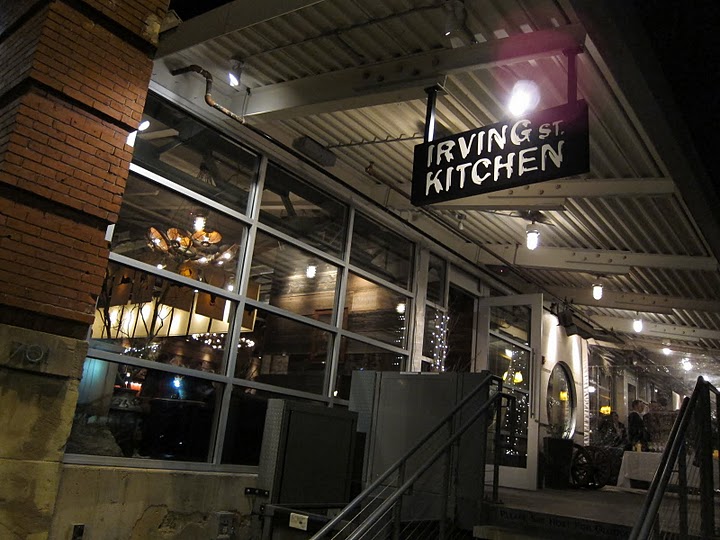
First stop: Irving Street Kitchen.

For the first stop, I wanted to find a place that was known both for its good food and good drinks.
Irving St. Kitchen was recommended to me on Hotpot because I had rated Beaker & Flask 5 stars and my Hotpot friends had rated Irving St. Kitchen highly.

The
Place page for Irving St. Kitchen had several Best Ever awards and most of them talked about the amazing drinks and bartenders such as Brandon Wise and Allison Webber. It seemed a perfect place to start our hop.

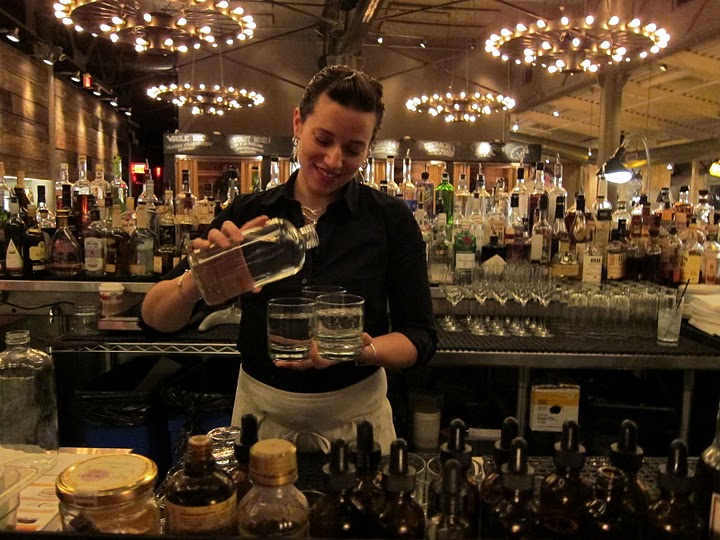
Allison Webber whips up something tasty.

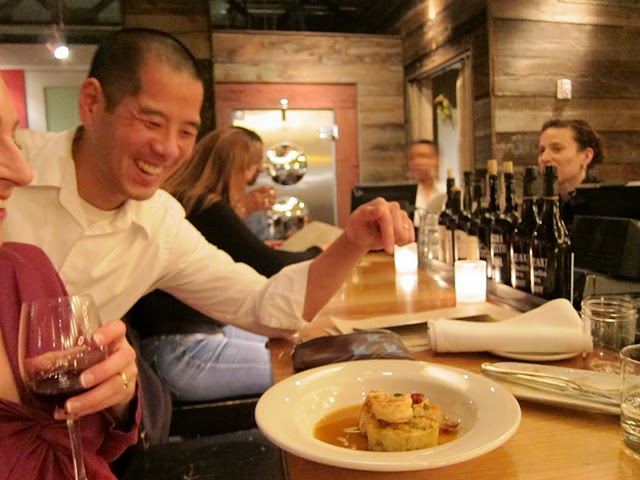
When we arrived at Irving St. Kitchen and took a seat at the bar, Allison made us a few great classic cocktails. My favorite was a variation of the Negroni — a White Negroni that was flavorful, balanced and a perfect before-dinner drink.

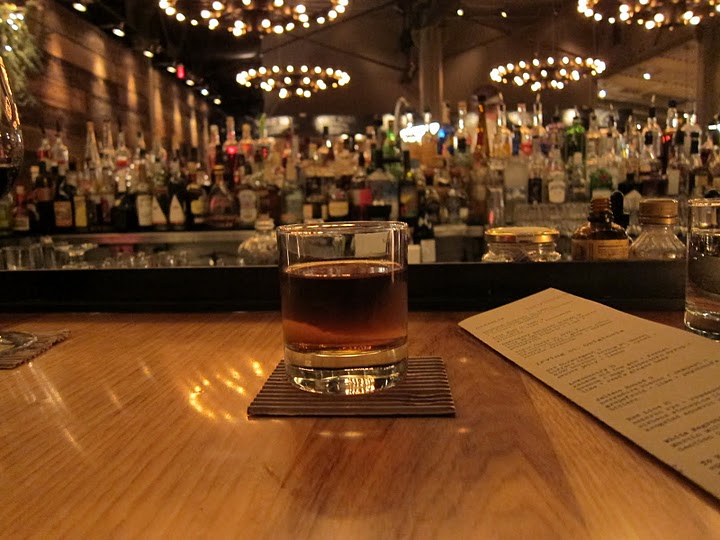
White Negroni at Irving Street Kitchen.

Allison made some food recommendations including a beet salad with truffles, fresh salmon over lentils, and our favorite dish of the evening, a shrimp and crab fusion dish served over a savory bread pudding.

Shrimp, crab and bread pudding - True Fusion at Irving Street Kitchen.

We probably could have spent the entire evening sitting at Irving Street’s bar, but we were on a mission to hop with Hotpot. Using the
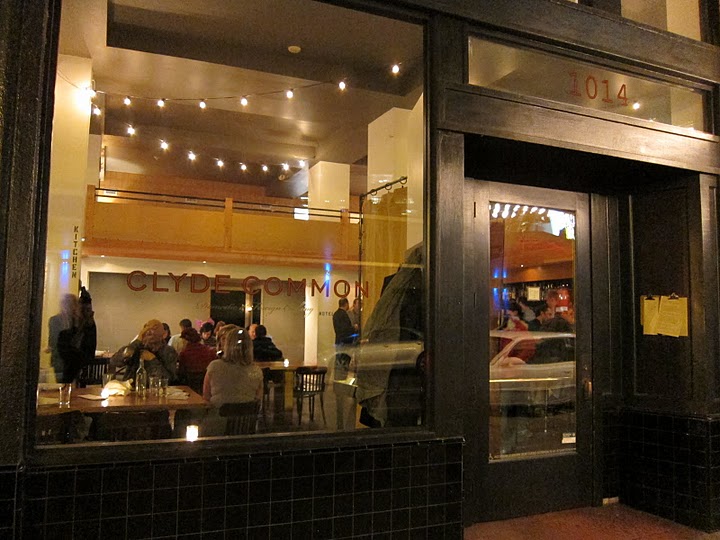
Rate Places widget for Android, we gave Irving St. Kitchen a glowing rating, then used the Android Places app to look for other bars nearby that friends had recommended. Clyde Common came right up. It was just down the street and recommended by our friend Jennifer Heigl on Hotpot.

Second stop: Clyde Common.

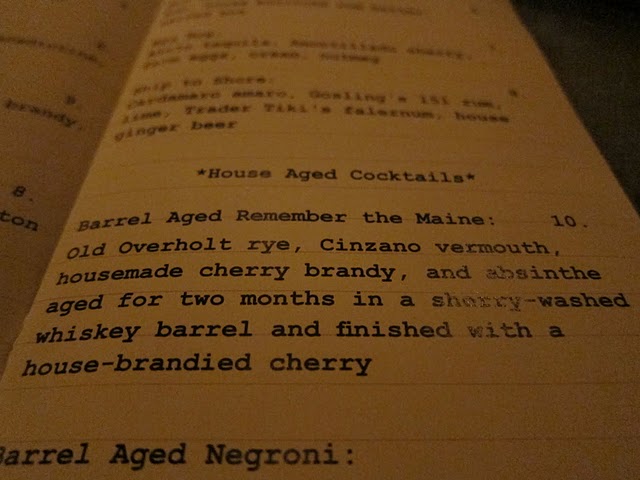
Checking out Clyde’s Place page, we read that the restaurant is the home bar for noted bartender and blogger Jeffrey Morgenthaler. Several of the reviews referred to the barrel-aged cocktails, so when we sat at the bar we immediately ordered one.

Jeffrey Morgenthaler's famous barrel-aged cocktails.

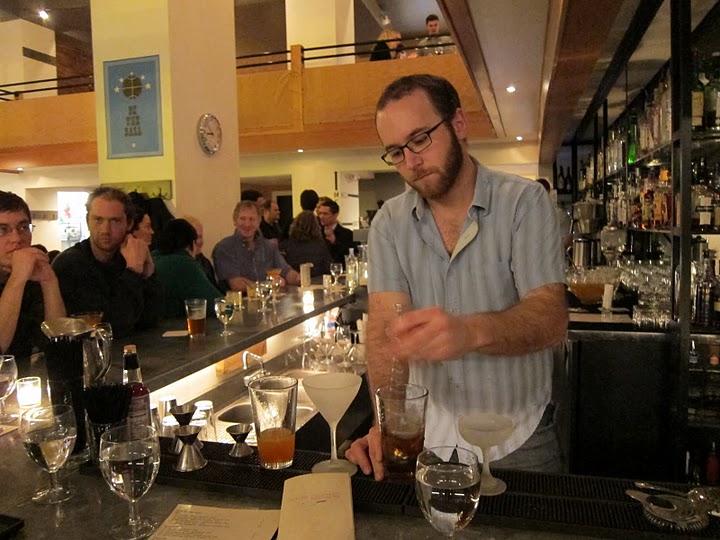
Jeffrey wasn't behind the bar that night, but Andrew Volk was, and in addition to mixing up a few barrel-aged drinks for us, he also made an original Islay scotch cocktail that simply blew us away.

Andrew Volk works the Clyde Common bar.

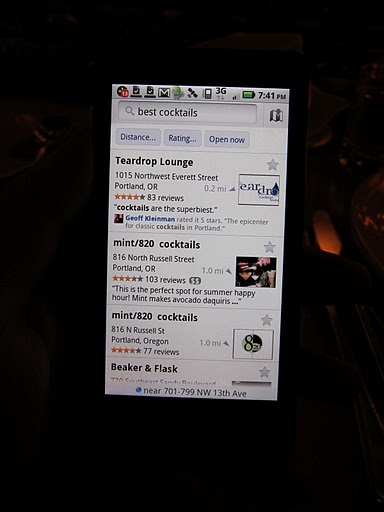
Clyde Common is a little bit of a way station bar, and we found that our group grew a bit as we headed along to our next stop. This time around, instead of looking for a nearby bar, we wanted to see what would happen if we just asked the Places app to
search for the "best cocktails."

Third and final stop: Teardrop Lounge.

So far Google Places with Hotpot hadn't steered us wrong, and it was doing a great job of being the “person in the know.”
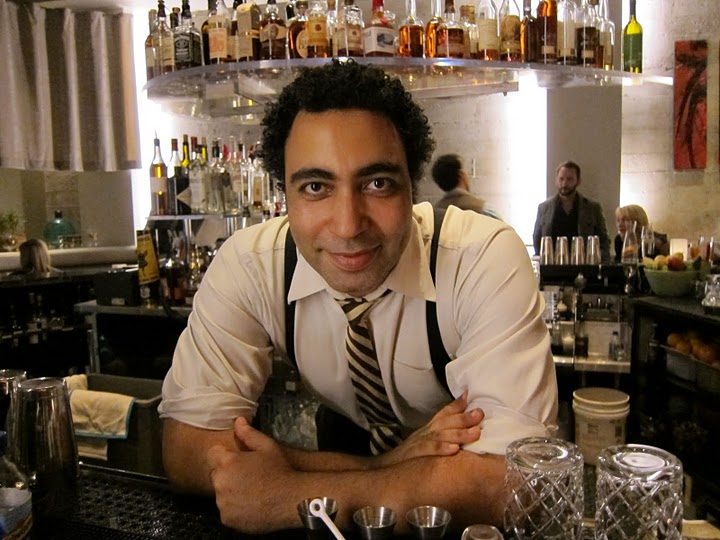
Teardrop Lounge came up on the list and it was just around the corner, so we made our way over. Many of the reviews on Teardrop’s Place page talked about its classic cocktails, so we sat at the bar and checked out the massive cocktail menu, which has close to 30 different drinks listed. A little daunted with the menu, we got help from bartender Brian Gilbert, who spent a lot of time with our group getting to know what kinds of things we drink.

Brian Gilbert helps us decide what drinks to order at Teardrop.

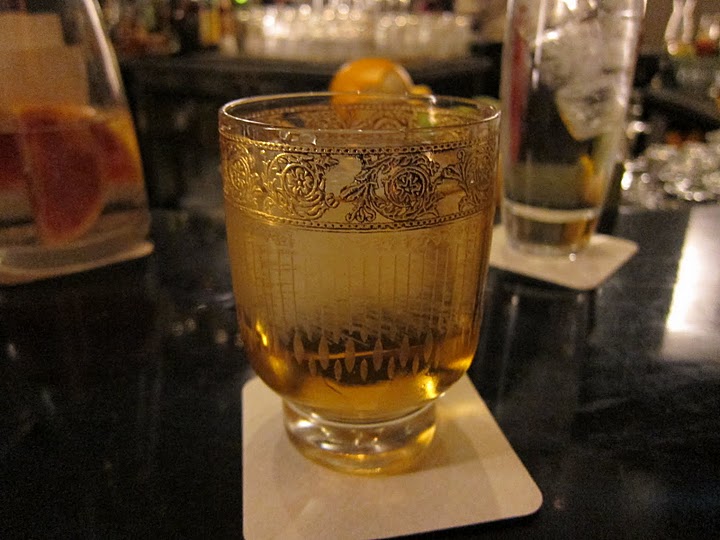
I ended up with a drink called “Unfinished Business,” which was served in a very cool antique glass with a huge block of ice.

One of Teardrop's many cocktail options, "Unfinished Business."

Having Hotpot recommendations as our guide for the evening took a lot of the guess work out of figuring out what to do and where to go. Even more helpful were the reviews and tips left by my Hotpot friends, so I knew exactly what to order.

Using Hotpot on your hops and crawls? Share your stories in the comments below.

Posted by
Geoff Kleinman. Geoff is the editor of DrinkSpirits.com, a national blog helping people figure out what to drink, and OnPDX.com, helping people figure out what to do in Portland.

Longer Term Trading and Today's Gap Trade in Detail

I promised to show you some of the longer term stuff I do. It's based on exactly the same methodology I use for day trading, but use different instruments in addition: ETFs and options as well as futures. I run the daily charts after the close of the U.S. stock market and sometimes when I get up early here in Europe.

The chart below is the ES daily. As you can see, FloBot, our auto trader, has signaled quite a few good trades in the last few months. The last trade was signaled at the close on 30 December, being a BUY. The algo that Flo uses for these longer term trades is almost identical to the day trading logic I use. Same logic over any market or time frame.

I got this signal and then had only to decide how I wanted to trade it. I had lots of choices including:
BUY the ES future
BUY the SPY ETF
BUY a 1255 Jan CALL Option
SELL a 1255 Jan PUT Option
BUY a 1255/1265 Jan CALL Option Spread
just to name a few choices.

I don't have to make these complex decisions every time, as each of the choices has its distinct risk parameter. I have created a trading plan that takes into account context, and almost makes which way I enter a trade automatic. The context I look at is different to my day trades, as these trades last for a few days and I want to sleep not worry.

Each of the choices has not only a different risk profile, but the stop versus possible profits vary.

In this instance, the correct entry for me was to BUY a 1255 Jan CALL Option  around 16 points. I then saw them trade @ better than 26 points: a 10 point ($500) on a capital requirement of $5,000. I could have sold the 1255 PUT and made $450, but I bought the CALL as the volatility of the ES options are low. Buying the future would have made $750 per contract, but with a larger downside risk than buying the CALL. The risk with the CALL was that it was eroding (losing its time premium). Lots to think about, but plenty of time to do it as it's only once a day trading.


At about 10:10am (London time) I tweeted the Gap trade was setting up and that I would look to do something as RTH got closer. I was considering that the ADP Jobs prediction may have an impact. I was focusing on the bottom of the zipper of the RTH Profile of Dec 31st and the dual POCs of Dec 30th 24hr profile. That was my get out area if it looked like not bouncing. So I bought the bounce off my fav Fib @ 1257 with the CCI divergence. My scales were each of the EMAs and then just before the gap close. Price moved up before the ADP number, which was a good number as it turned out. My exits at the EMAs were both hit. Ching! Ching!

My last target for the final 1/3rd of the position was the top of the Keltner Channel. Doesn't always turn out this easy, as knife catching can be a sport that cuts more than just your hands. The structure and the plan were critical to taking and managing this trade. I was done and dusted before the RTH session even started.


Selasa, 04 Januari 2011

What is Order Flow?

The expression ORDER FLOW seems to have spread all over the boards on the web in the last few months. People make assumptions about what the expression means in trading and how it manifests itself, how the trader can discover or see it and, most importantly, how the trader can use it to make money when he identifies it correctly.

Firstly, it is said that Order Flow is VOLUME. Volume is a number and you can't see a number. You can count items and when you add them up you get a number. On the floor we saw the transactions. We saw whether the broker who brought the "paper" had his palms facing towards himself or away from himself. We could look around the pit and see the hand signals that told us how many contracts were trading. We don't have that with electronic trading.

But we do have other tools.

For example, we have MarketDelta's Volume Breakdown which identifies whether a trade took place at the Bid or Ask. We have the MarketDelta Footprint which puts this information into a structure. But that is only part of the story. This is not just The Age of Aquarius, it's the super hi tech age. The big guys have big bux that they throw at their trading. They also hire guys with big brains. They don't want the whole world to know what they are doing so they try and hide it as much as they can until they're ready for us to know, by which time it's usually too late. We have by then, swallowed the frog.

When I was a kid, there was this great movie, in black and white, called "The Invisible Man". You probably have heard about it or about one of the many remakes. Great movie based on a story by H G Wells. Unless the Invisible Man wanted to be seen, which was when he wrapped bandages around his face and put on clothes, we couldn't see him. But when he was invisible and we looked hard, we could see his footsteps on the ground where he went.

That's what we do today in the electronic markets. We "deduce" the order flow not just from what is revealed clearly but from it's footsteps. What can we see? We see the Market profile and the types and lack of rotation. We can measure the momentum. We see price, of course, and it's direction as it changes and the speed with which it changes. And of course, we can see where it is located from what is considered a fair price.

It takes all of this for me to see the Order Flow and the tools I have shown in the blog are what I use to identify it. Of course I'm always looking for better tools too.

BTW, I have started tweeting to StockTwits and Twitter as you can see from the right hand side box on this blog. I don't know how intrusive I'll find it, but I may be able to give a "heads up" on a few things if I can post and trade at the same time.

I was scalping the Euro today as you might have seen me tweet. I reduced the range bar to 3 ticks. It was pretty tiring. I was looking for 5 to 7 ticks profit per trade. I was trading in the European morning, took a break to take Kiki to the airport and scalped in the afternoon.

This type of trading can also be done as HT (see yesterday's post). When the context sets up, I can just switch on the version of Flo that suits and let her do the entries with me just managing the trades with exits. This type of scalping can pull in 100 ticks/contract on a good day, especially using Flo when I don't get so tired from concentrating. I think I'll make a new DVD on scalping manually and using an autobot and add it to the training course. I'll let you know when it's there.


Senin, 03 Januari 2011

A New Year, Hybrid Trading and Longer Term Trading

I am hugely excited about the start of a new year. All the expectations, back from a good rest and new ideas for the blog and training.

First, Hybrid Trading. I have touched on HT in this blog before, but I think that it is now deserving of more attention as it's something I will be addressing in the new training materials I am preparing this year for both longer term trading and day trading.

Firstly, what is Hybrid Trading?  HT, as I refer to it, is using the computer to identify the most common entries and execute them, and then leave the management of the trade to me. In some cases, I need to exit immediately as I don't like the context. So what's the benefit? Quicker entries, not needing to be so focused, being able to trade more than one market at a time and so on. As soon as the trade is executed by the platform, I turn the auto trader off and manage the trade. I expect to do more of this as the year progresses. Our FloBot has improved a lot over the last year and to give Flo extra duty seems like a good idea for my bottom line.

I am also going to talk about some longer term trades. Trades that last a few days. The methodology for these trades is virtually the same as for my day trading, but uses daily data and MarketProfile a little differently. I use a variety of instruments in this longer term trading: futures, ETFs and options. The instrument of choice for a particular trade depends on the context of the trade. Not too complicated, but requires a little more thinking. As I'm using daily data, I only have to do this outside market hours and I have plenty of time to make my decisions. I use Flo to identify the trades, as there are more markets involved: S and P, Gold, Coffee (I'm Nespresso's favourite customer), Oil, Euro and Treasury Notes as a start. More markets to be added.

I'll keep the longer term trading in this blog, but may make a second post at around 1 am or so, New York time, as I usually do the analysis early in the morning European time. Let's see how it goes.

I'm also planning on using Twitter and StockTwits more in market related activity. Candace has some good ideas and I'll see what I can do so that readers can learn during market hours if they want.

I was skiing in the morning with Kiki (she's a board rider) so no work in the morning but the year went off to a good start with a couple of ES trades. The Gap trade did not trigger so the only way was up, as the song says. Nothing to lean against on the sell side. The pic below shows the trades.

Rabu, 29 Desember 2010

Happy Holidays - Yes a Little Late

Happy Holidays even if it is a little late.  Just like my birthday (happens very close to Christmas) I got caught up in the swinging of things and let a few others go. But never fear I am back and here is another fascinating edition of small business news for Southeast Missouri. I got a bit of good news today - a client of mine was able to obtain a small business loan. This client is one of six

PET third stage COTS tank

.


Before:


During


After


Betterbottle makes 5 and 6 gal PET water bottles. I could only find a source for the 5 Gal, so that is what I tested.

Empty 674 gm
MR with water of 29 with peroxide 39!
Burst at 125 PSI.
Long period of plastic deformation at around 100 psi
It burst in the thin center with the ends remaining substantially thicker.
This means one could probably prevent the banana deformation and increase the pressure with a center overwrap.